Hue Royal Architecture Temple in Saigon is Over nearly 200 years, Lang Ong Ba Chieu (Man & Women Mausoleum is also deeply imbued with the sophisticated reliefs made of porcelain. It is located in an area of 18,500 m2, next to Ba Chieu Market (Binh Thanh District, Ho Chi Minh City), Lang Ong also has the folk name of Lang Ong Ba Chieu, the burial place of Le Van Duyet, the Governor. Gia Dinh ancient city. This is also an architectural work with unique cultural and artistic values of the Southern region.
Link: Bike Tours from Ho Chi Minh City.
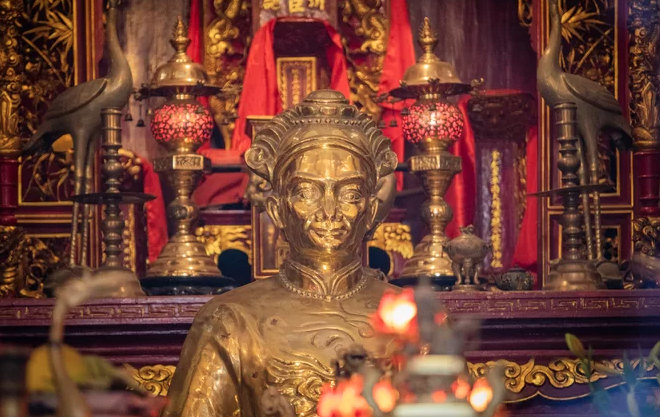
Le Van Duyet Statue
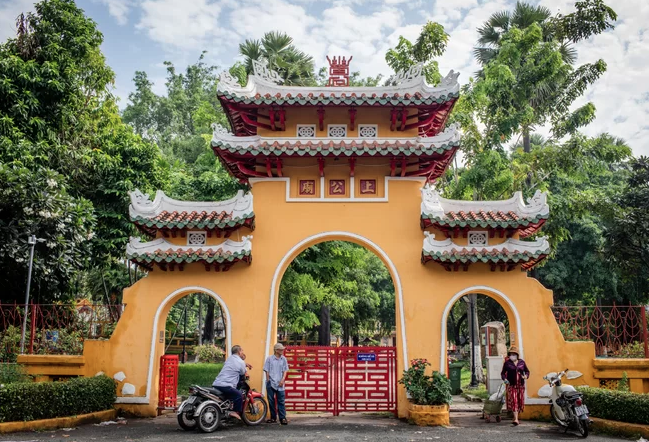
The relic is surrounded by greenery, on a high mound of turtle-like shape, believed to be a "privileged" position. The mausoleum has 4 gates, in which the main gate in the south (which opens Vu Tung Street) is designed in Tam quan style, above with three words "Thuong Cong Mieu" engraved. The project was built according to the project of architect Nguyen Van Tan in 1949 and used to be the symbol of Saigon (and the South) with Phuoc Duyen tower of Thien Mu pagoda (symbol for Hue and Central), One Pillar Pagoda - Dien Huu Pagoda (symbol for Hanoi and the North).
From Tam quan gate, visitors can clearly see the architectural axis of the tomb including: Beer house, tomb and shrine. According to historical sources, the worship of Ta Van Le Van Duyet was only officially publicized when he was vindicated in 1849, then King Tu Duc gave a reconstruction and established a shrine. By 1914, the worship was expanded by the birth of Thuong Cong Quy Te, an organization of volunteers, who knew the custom of taking care of worship, restoration and construction of shrines.
Tomb of Le Van Duyet and his wife Do Thi Phan are valuable places and the oldest architecture of the relics. The whole burial site was built with an ancient polluted compound. The two graves are parallel and constructed in the same way, shaped like a half-faced egg on a large rectangular base. So today, the distinction of his grave and her grave is controversial.
In front of the grave area are two unicorns, especially the statue on the right to carry a unicorn (unicorn). There is a theory that the grave along the side of this unicorn statue is the grave of Ta Van Le Van Duyet.
The "accessory code" with porcelain material, glass on the wall of the electricity area. According to research by Bui Thi Ngoc Trang, Ph.D., in addition to the two traditional materials, wood and stone, the art of crockery at the shrine is a technique recruited from the architectural works in the ancient capital of Hue. With all kinds of porcelain pieces, broken and colorful glass ... Artisans have skillfully selected and arranged into vivid works of art.
Porcelain crockery uses the image of a dragon-carp carp fighting with a decorated bird in 1937 on a shrine. According to the concept of folklore, the image of the dragon carp is a symbol of fighting spirit, always looking for ways to overcome difficulties to reach a good future.
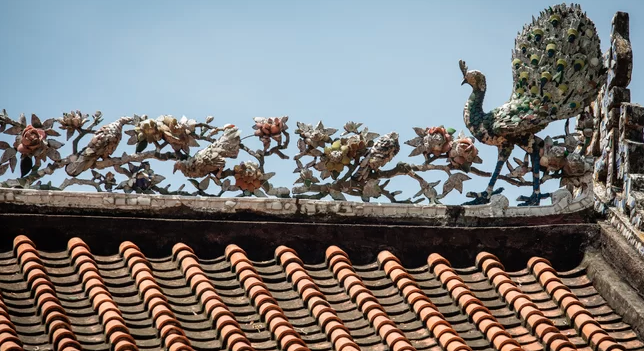
On the roof of the temple is also decorated with images of many different animals and motifs such as pheasant, public, lotus, peony ... to express the topics that bring reality, close to life. human.
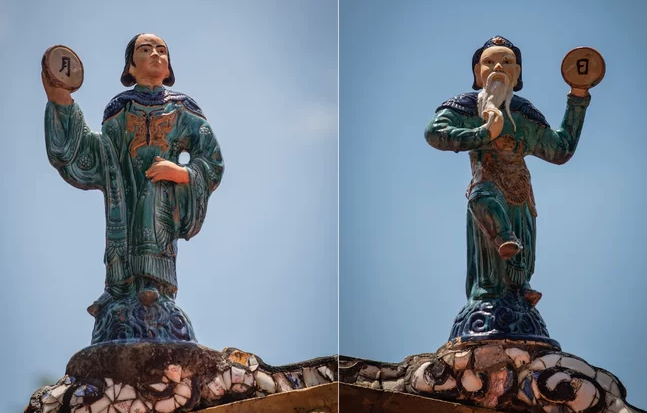
Pair of Mr. Nhat and Mrs. Nguyet statue on the roof of the house of electricity shows the concept of the universe and the life of two Vietnamese and Chinese communities in Saigon - Gia Dinh. This is also one of the rare projects using the art of humanoid decoration at the tomb.
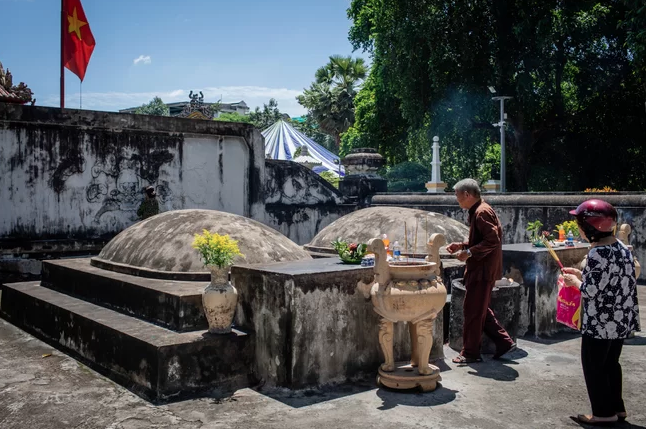
Le Van Duyet Tomb
The shrine area, called Thuong Cong Linh Mieu, consists of Tien Dien, Trung Dien and Chinh Dien, with the main red and gold colors. According to the Management Board of monuments, the above three sections have some differences in materials and structural engineering inside but the two-storey roof is still a common feature, reflecting the traditional Vietnamese architecture. The altar between the main hall is the statue of Ta Van Le Van Duyet, which is cast in pure copper based on his portrait pattern printed on the 100-dong bill circulated in Saigon before 1975.
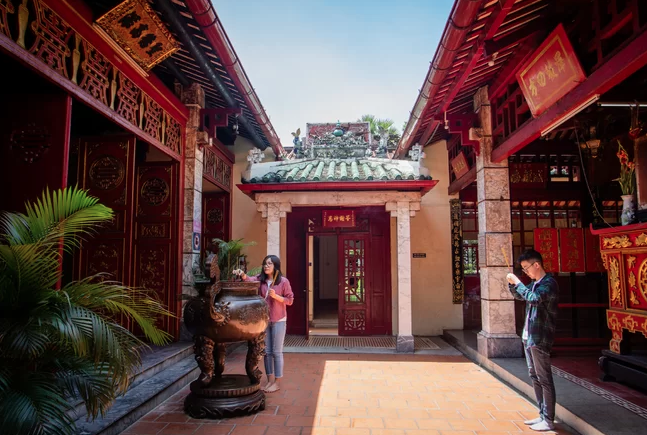
Sky Well
German Army born in 1764, died in 1832, was one of the ranks of the Nguyen dynasty. At the time of his birth, he was a noble, virtuous officer and admired by the people as "The Great King". His merit was granted by King Gia Long with many privileges such as "Entering the tide of immortality" (in the dynasty, there was no kneeling) and "Money of post-decimation" (slashing before the later). See Cycling Vietnam Routes.
Young people light incense at the static courtyard (sky well), where connecting the central and main electricity of the mausoleum. Statistics of the Management Board of monuments, on average every day, welcome from 100-200 domestic and international visitors, especially on the New Year holidays, over 100,000 people visit and visit the scene.


